Octopuses Really Do Have Three Hearts and “Nine Brains”
The famous octopus fact is mostly right, but “nine brains” is shorthand rather than a human-style anatomy claim. Octopuses have a central brain plus large, partially autonomous neural systems in their arms, along with three hearts and copper-based blue blood that fits life in challenging marine environments.
Published
Filed under
Byline
 Brainblast archive
2026-03-01-23-35-36-octopus-anatomy.png (source: app assets)
The fact
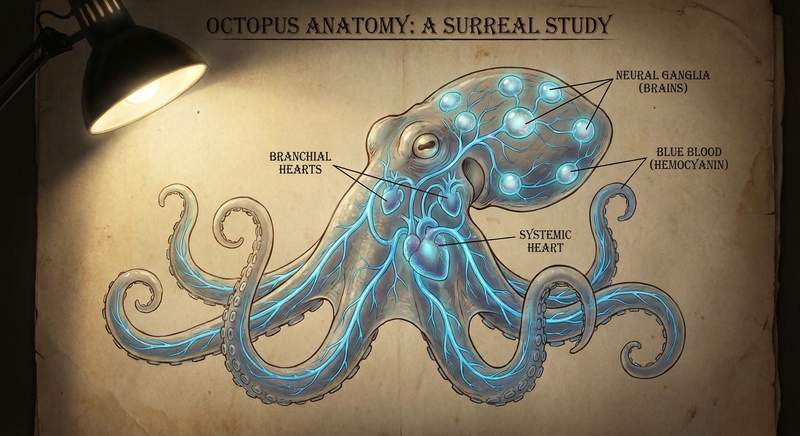
“Octopuses have three hearts, nine brains, and blue blood. Two hearts pump blood to the gills, while the third pumps it to the rest of the body.”
The short version is real: octopuses have three hearts, blue blood, and a nervous system spread so widely through the body that people often summarize it as “nine brains.” The Natural History Museum’s octopus explainer states the headline plainly: blue blood, three hearts, and a doughnut-shaped brain, plus powerful local control in the arms. The University of Chicago’s report on octopus arm nervous systems adds fresh anatomical detail by showing how elaborate the arm circuitry really is.
The three-heart part is the easiest to summarize. NHM’s article explains that one heart circulates blood around the body while two others pump it past the gills to pick up oxygen. That division of labor fits the octopus lifestyle, because cephalopods are active predators with demanding oxygen needs. The hearts are not a gimmick; they are part of a specialized circulatory system.
The blood color is also no myth. NHM notes that octopus blood is blue because it relies on hemocyanin, a copper-containing oxygen carrier, rather than the iron-containing hemoglobin that makes vertebrate blood red. In cold, low-oxygen marine environments, hemocyanin can be very effective. So “blue blood” is not aristocratic metaphor here. It is respiratory chemistry.
The “nine brains” claim is where the caution signs appear. NHM’s article says each arm contains its own “mini brain,” which is a useful popular shorthand because the arms can taste, touch, and move with remarkable independence. But that does not mean an octopus has nine separate little skull-brains each writing its own memoir. The more precise description is a central brain plus large, distributed neural systems in the arms.
That distributed architecture is not just a metaphor. The University of Chicago’s 2025 report says each arm has a massive nervous system, with more neurons across the eight arms combined than in the animal’s brain. The study describes a segmented axial nerve cord running down the arms, helping explain how octopuses achieve such dexterous, flexible control. In other words, the “mini brain” idea survives because the arm nervous systems are genuinely powerful, not because science journalists got carried away.
This arrangement changes how we imagine octopus behavior. A vertebrate body usually sends commands outward from a dominant central brain. An octopus still has central control, but NHM describes a system in which local arm processing and centralized oversight coexist. The UChicago report suggests the arm circuitry is organized to support dynamic, sucker-rich movement in a soft-bodied animal. That means an octopus does not merely have many limbs; it has many semi-independent problem-solving appendages.
The famous anatomy facts also connect to ecology. Three hearts and copper-based blood help support a predatory marine life. Distributed neural control helps manage eight hyper-flexible arms that explore cracks, grasp prey, manipulate objects, and coordinate hundreds of suckers. The strange anatomy is not a collection of random oddities. It is a coherent solution set for being an intelligent, soft-bodied hunter in the ocean.
That coherence is what makes the anatomy memorable instead of merely weird. The Natural History Museum emphasizes that octopuses are behaviorally sophisticated, while the University of Chicago report helps explain how a distributed nervous system can support that sophistication in practice. Their bodies are not overdesigned curiosities; they are highly functional solutions to a very demanding way of life.
Popular retellings sometimes oversell the “alien” angle, as if octopuses prove life can evolve outside all recognizable rules. The better lesson is nearly the opposite. Octopuses are so fascinating because they show how many different elegant engineering answers evolution can build within life on Earth. NHM’s overview highlights their intelligence and decentralization, while UChicago’s arm study shows that the decentralization has real anatomical structure.
So the meme is mostly right once translated. Octopuses do have three hearts, and their blood really is blue, as the Natural History Museum explains. They also have such extensive arm nervous systems that calling them “nine-brained” works as shorthand, especially in light of the University of Chicago’s report on segmented arm circuitry. The only repair needed is semantic: “nine brains” is a vivid simplification of distributed neural control, not a literal stack of nine equivalent brains in the vertebrate sense or some mystical exception to biology.