Deep-mantle 'blobs' are real; calling them remnants of Theia is still a hypothesis
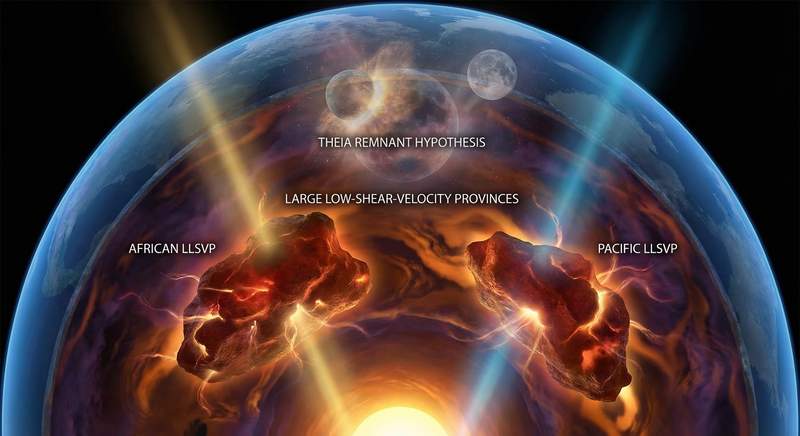
Seismology has long revealed two enormous slow-wave structures near the core-mantle boundary beneath Africa and the Pacific. What is well established is that these large low-velocity provinces exist; what remains unsettled is exactly what they are made of and whether they really include remnants of Theia, the putative impactor linked to the Moon’s formation.
Published
Filed under
Byline
 Brainblast archive
2026-03-06-05-33-00-theia-remnants-earth-mantle.png (source: app assets)
The fact
“Seismic imaging has revealed two continent-sized structures of mysterious, dense material buried 1,800 miles deep within the Earth's mantle, located beneath Africa and the Pacific Ocean. Known as Large Low-Shear-Velocity Provinces, these 'blobs' are thousands of miles wide and are hypothesized to be the remnants of Theia, an ancient protoplanet that collided with Earth 4.5 billion years ago to form the Moon.”
The basic claim starts on very solid ground: seismologists really have identified two enormous anomalous regions deep inside Earth, one broadly beneath Africa and one beneath the Pacific. These features are commonly called large low-velocity provinces, or LLVPs, because seismic waves travel unusually slowly through them. The Annual Review of Earth and Planetary Sciences article on mantle seismic heterogeneity treats these structures as robust large-scale patterns in global tomography, not fringe speculation. The Caltech explainer on a 2023 study likewise notes that geophysicists first recognized these deep “blobs” decades ago.
So the real scientific question is not whether the blobs exist. It is what they are. And that is where the viral version of the fact tends to skip a step. The Caltech article says each blob is continent-sized—indeed, it describes them as each being roughly twice the size of the Moon—and likely composed of material with different elemental proportions than the surrounding mantle. The Annual Review article frames these slow-velocity regions as evidence for major compositional or thermal heterogeneity in the deep mantle. In plain English, the blobs are real, but their exact recipe is still under active investigation.
The headline-grabbing Theia story comes from one specific and recent hypothesis. In the Nature paper “Moon-forming impactor as a source of Earth’s basal mantle anomalies”, researchers proposed that the Moon-forming impactor—commonly called Theia—could have left iron-rich mantle material inside Earth after the giant collision that also led to the Moon’s formation. The Caltech summary says their simulations suggest much of Theia may have been absorbed into the young Earth, where some of that material later clumped into the present-day LLVPs, while other debris contributed to the Moon.
That is a fascinating idea, but it is not the same thing as a settled identification tag reading “Theia remnants.” The Annual Review article emphasizes that seismic tomography reveals velocity heterogeneity, not simple visual photographs of composition. Slow waves can reflect temperature differences, compositional contrasts, partial melt, or some combination of those factors. The Nature paper is therefore best understood as a model that connects planetary-impact theory with deep-mantle seismology, not as the final word closing the case.
This distinction matters because the blobs were already scientifically interesting before anyone linked them to Theia. The Annual Review paper describes mantle tomography as a major constraint on Earth’s internal circulation and evolution. LLVPs appear near the core-mantle boundary, influence how researchers think about plume formation, and may represent long-lived reservoirs with compositions distinct from ordinary mantle rock. Even if the Theia interpretation were someday revised or replaced, the blobs themselves would remain central to our picture of how Earth’s deep interior works.
The seismological method also deserves a little respect here. No one drilled down 2,900 kilometers and scooped out a sample. Scientists infer these structures by tracking how seismic waves from earthquakes move through the planet. The Caltech article explains that researchers noticed large-scale three-dimensional variations because waves travel at different speeds through different materials. The Annual Review article stresses how advances in tomography improved the resolution of those deep patterns. That is powerful evidence, but it is inherently indirect evidence.
Another reason for caution is that deep Earth models often compete rather than neatly stack. Long before the 2023 Theia proposal, geophysicists had discussed possibilities such as primordial reservoirs, thermochemical piles, or material related to ancient mantle differentiation. The Nature paper enters that debate with a bold synthesis: maybe a giant impact supplied dense, iron-rich material that survived deep in the mantle. It is compelling because it links two famous mysteries at once—Moon formation and the origin of LLVPs—but dual usefulness is not proof.
What makes the idea scientifically exciting is that it is testable in principle. If LLVPs really contain impactor-derived material, that should have implications for density, iron content, isotopic history, and the behavior of plumes rising from the deep mantle. The Caltech summary presents the study as a multidisciplinary effort combining geophysics and planetary-impact modeling. The Annual Review article likewise shows why better seismic imaging is crucial: improved pictures of Earth’s interior help scientists decide among competing origin stories.
So the repaired fact is more precise and more interesting. Seismic imaging has indeed revealed two enormous deep-mantle structures beneath Africa and the Pacific, as discussed in the Annual Review article and summarized by Caltech. What remains debated is their composition and origin. The 2023 Nature paper proposes that they may include remnants of Theia, the putative Moon-forming impactor. That is a serious scientific hypothesis, not a crank idea—but it is still a hypothesis. Earth’s deepest blobs are real. Their backstory is the part scientists are still prying out of the planet, one seismic wave at a time.