The Boomerang Nebula, located 5,000 light-years away, is the only...
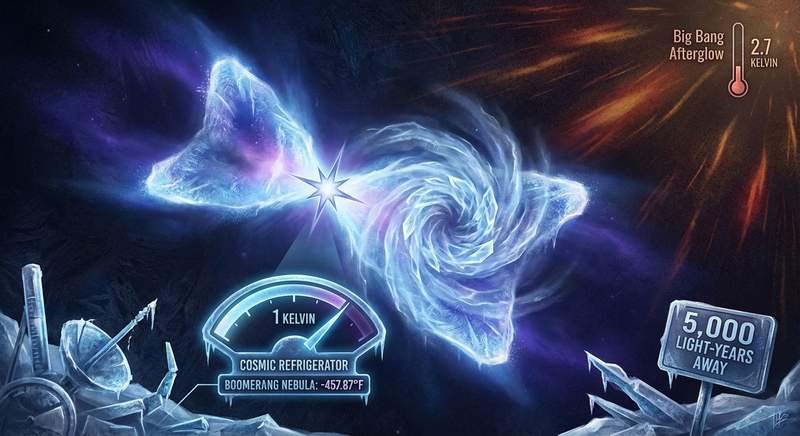
The Boomerang Nebula is the coldest known natural object ever observed, with gas colder than the cosmic microwave background because an ultra-fast outflow cools through expansion.
Published
Filed under
Byline
 Brainblast archive
2026-03-06-09-33-00-boomerang-nebula.png (source: app assets)
The fact
“The Boomerang Nebula, located 5,000 light-years away, is the only known natural place in the universe with a temperature colder than the afterglow of the Big Bang. It maintains a steady temperature of just 1 Kelvin (−457.87°F) because the gas expelled by its central star expands so rapidly that it creates a "cosmic refrigerator" effect through adiabatic cooling.”
The Boomerang Nebula is often described as the only known natural place in the universe colder than the afterglow of the Big Bang. That claim is close to the evidence, but the careful version is even better: it is the coldest known natural object ever observed, and parts of its outflow are cold enough to absorb the cosmic microwave background, which sits at about 2.725 kelvin. NASA’s Jet Propulsion Laboratory reported long ago that the cold region is about 1 kelvin, while later ALMA observations suggested some of the ultra-cold outflow drops below half a kelvin in places (https://www.jpl.nasa.gov/news/boomerang-nebula-boasts-the-coolest-spot-in-the-universe/; https://www.almaobservatory.org/en/press-releases/alma-returns-to-boomerang-nebula/).
That sounds backwards at first. Deep space is supposed to be cold, so how can anything be colder than space itself? The trick is that “space itself” is not absolute zero. The universe is filled with the cosmic microwave background, leftover radiation from the early universe. It provides a natural temperature floor of about 2.7 kelvin. To be colder than that, an object has to cool itself so efficiently that it can actually absorb that background radiation rather than merely sit in equilibrium with it. The Boomerang Nebula does exactly that, which is why astronomers treat it as such a weird and valuable object.
The nebula lies about 5,000 light-years away in Centaurus and is not yet a fully developed planetary nebula. It is a pre-planetary nebula, a short-lived stage in which a dying star has shed large amounts of gas and dust but has not yet heated enough to ionize the whole envelope. ALMA explains that the Boomerang’s central star is in the transition toward becoming a white dwarf, while its surrounding gas is still dominated by an expanding, cold molecular outflow rather than the glowing shell people often picture when they hear “planetary nebula” (https://www.almaobservatory.org/en/press-releases/alma-reveals-ghostly-shape-of-coldest-place-in-the-universe/).
So why is it so cold? The short answer is adiabatic expansion. Gas that expands very rapidly can cool dramatically, much the way expanding refrigerant cools in a household refrigerator. JPL explicitly called the Boomerang a “cosmic refrigerator,” and ALMA later showed that the outflow is racing outward so fast that the temperature plummets far below the cosmic background (https://www.jpl.nasa.gov/news/boomerang-nebula-boasts-the-coolest-spot-in-the-universe/; https://www.almaobservatory.org/en/press-releases/alma-returns-to-boomerang-nebula/). In the 2017 ALMA interpretation, the outflow appears to be moving about ten times faster than a lone red giant should manage on its own.
That last point leads to the next wrinkle: the Boomerang Nebula is not just cold, it is mechanically odd. Astronomers increasingly suspect that a companion star plunged into the envelope of the red giant at the center. That interaction could have dumped enough energy into the system to eject the envelope violently, producing the enormous, ultra-fast outflow required for such extreme cooling (https://www.almaobservatory.org/en/press-releases/alma-returns-to-boomerang-nebula/). In other words, the nebula’s record-setting cold may depend not only on a dying star, but on a messy binary interaction.
The object also fooled astronomers visually. Early images suggested a lopsided or bow-tie-like shape, which is how it got the name “Boomerang.” ALMA’s millimeter observations revealed that the visible-light shape was incomplete and somewhat deceptive. The cold molecular gas is much broader and more elongated than the pretty optical images alone suggest, and the outflows span nearly four light-years across the sky (https://www.almaobservatory.org/en/press-releases/alma-reveals-ghostly-shape-of-coldest-place-in-the-universe/; https://www.eso.org/public/images/potw1724a/). That matters because the geometry helps explain how such a large volume of gas can remain so cold.
There is, however, an important caveat to the “only known place colder than the Big Bang” slogan. Astronomers can only compare with what has been observed. The Boomerang Nebula is the coldest known natural object, not a mathematically proven unique object in the entire cosmos forever. Human-made laboratory systems on Earth can be far colder, of course, but those do not count as natural astrophysical environments. Within nature as presently observed, the Boomerang still holds the crown.
Another caveat is that the whole nebula is not sitting at one uniform temperature. Different observations refer to different regions of the outflow. The older JPL account highlighted gas around 1 kelvin, while the later ALMA work described parts of the outflow as even colder than that and also noted that some outer fringes are warming again as the system evolves (https://www.jpl.nasa.gov/news/boomerang-nebula-boasts-the-coolest-spot-in-the-universe/; https://www.almaobservatory.org/en/press-releases/alma-reveals-ghostly-shape-of-coldest-place-in-the-universe/). The record belongs to the coldest measured parts, not to every grain of dust in the nebula equally.
So the durable takeaway is this: the Boomerang Nebula is extraordinary because it is not merely very cold. It is cold enough to beat the background temperature of the universe itself, thanks to a violent, rapidly expanding outflow from a dying star system. That makes it less like an icy cloud and more like a naturally occurring astrophysical refrigeration experiment—one that lets astronomers watch stellar death, gas dynamics, and extreme thermodynamics all in the same eerie object.