The Boötes Void Is Real—But “A Giant Hole of Nothing” Is an Oversimplification
The Boötes Void is one of the most famous cosmic voids ever identified: a vast region with far fewer galaxies than astronomers would normally expect. The careful version of the fact is not that space has a perfect empty bubble punched out of it, but that surveys confirmed an unusually underdense, roughly spherical region in Boötes whose exact size and galaxy count depend on how the boundary is defined.
Published
Filed under
Byline
 Brainblast archive
2026-03-05-22-33-00-bootes-void.png (source: app assets)
The fact
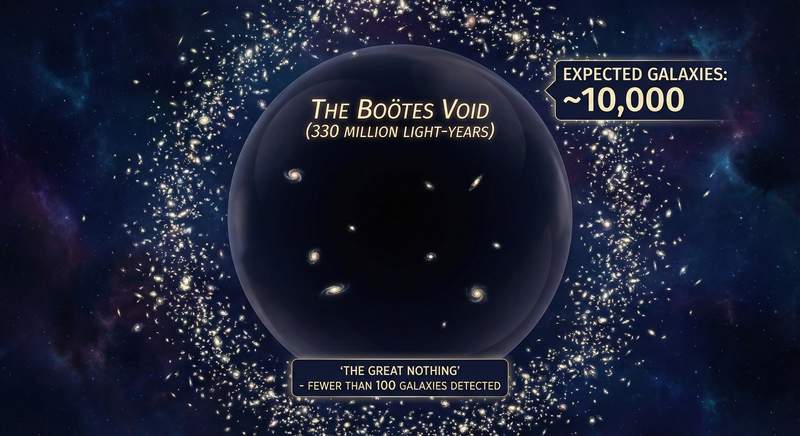
“The Boötes Void is a staggering, nearly empty spherical region of space approximately 330 million light-years in diameter, often referred to as 'The Great Nothing.' While a volume of this size should statistically contain around 10,000 galaxies, astronomers have only identified fewer than 100 within its vast boundaries. If the Milky Way galaxy had been positioned at the center of this void, humanity likely wouldn't have discovered the existence of other galaxies until the 1960s.”
The Boötes Void sounds like the kind of thing a science-fiction writer would invent after a strong cup of coffee: an enormous region of space with astonishingly few galaxies in it. The broad claim is true. Astronomers really did identify a giant underdense region in the direction of the constellation Boötes, and the original ADS abstract for “A Survey of the Bootes Void” says the follow-up redshift survey confirmed “a large, roughly spherical void” with a radius of 62 megaparsecs. That is enormous on human terms and still huge on cosmological ones.
But the internet version often overstates the emptiness and the precision. It is not a perfectly carved-out orb of absolute nothingness. The 1987 survey abstract says the region has very low density and high statistical significance, yet it also notes that the void does contain some unusual galaxies. Likewise, Astronomy magazine’s recent guide says the Boötes Void has revealed only a couple of handfuls of galaxies, not zero. That difference matters, because “void” in cosmology means underdense, not literally empty.
Part of the confusion comes from size estimates. Popular summaries often call it about 300 to 330 million light-years across. Sky at Night uses that sort of scale, saying the void spans about 330 million light-years across, while Astronomy calls it some 300 million light-years across. The original survey abstract, however, gives a radius of 62 megaparsecs, which corresponds to a diameter closer to about 400 million light-years. Those figures are not necessarily contradictions so much as reminders that cosmic structures do not come with neon outlines. Reported sizes depend on survey depth, coordinate conventions, and where astronomers decide the underdense region effectively ends.
The same caution applies to galaxy counts. Viral posts sometimes say a volume this size “should” contain 10,000 galaxies and instead contains only 60. Sky at Night says we would normally expect around 2,000 galaxies in a comparably sized region and that the void contains only around 60 or so galaxies. Astronomy phrases it more loosely as “a few thousand” expected galaxies and only a couple of handfuls identified. Neither phrasing changes the main point: compared with the cosmic average, the region is spectacularly sparse. But the exact comparison depends on which survey, threshold, and definition you use.
What makes the Boötes Void scientifically important is not just its emptiness, but what it says about the large-scale structure of the universe. Astronomy describes galaxies as gathering along filaments, groups, clusters, and superclusters, with voids occupying the gaps between those structures. Sky at Night explains the same idea through the “cosmic web”: slight density differences in the early universe grew over time, leaving some regions crowded and others depleted. The Boötes Void is famous because it is one of the most dramatic examples of that depletion.
It also became famous because it was unexpected. The ADS abstract says the low density did “not appear easily reconcilable with any of the popular models for the growth of structure in the universe” then in play. That line helps explain why the discovery got such attention. A huge void was not merely a visual curiosity; it put pressure on cosmologists to refine how they modeled the evolution of structure from the early universe to the galaxy web we map today.
Even so, the void is not a supernatural hole and does not mean something scooped matter out with a cosmic melon baller. Sky at Night and Astronomy both frame it as a product of ordinary large-scale structure formation, where matter flows preferentially into denser filaments and clusters, leaving vast underdense zones between them. In that sense the Boötes Void is weird, but not law-breaking weird.
It is also a good reminder that names can mislead. “The Great Nothing” sounds absolute. The original survey abstract shows it is instead a region with a severe shortage of ordinary galaxies, while Astronomy and Sky at Night both note that some galaxies do exist inside it. The better phrasing is that the Boötes Void is one of the best-known giant cosmic voids—enormous, real, and surprisingly sparse, but not literally empty.
So the repaired fact holds up nicely: the Boötes Void is indeed a vast underpopulated region of space in Boötes, confirmed by survey work such as the 1987 study abstracted by ADS. But if you want to sound more like a cosmologist and less like a clickbait headline, say that it is a giant underdense supervoid whose exact diameter and galaxy count depend on how astronomers map its boundaries, not a perfect spherical hole containing nothing at all.