The Great Attractor Is Not a Single Monster Object—It’s a Flow Region in a Hidden Part of the Sky
The Great Attractor is a real feature of local cosmology, but the careful version of the fact is subtler than the viral one. It refers to a concentration of mass and the peculiar motions it induces in our region of the universe, especially near the Norma Cluster behind the Milky Way’s Zone of Avoidance, and later work places it within the broader flow structure of Laniakea rather than treating it as one isolated mysterious object.
Published
Filed under
Byline
 Brainblast archive
2026-03-06-16-44-26-fact.png (source: app assets)
The fact
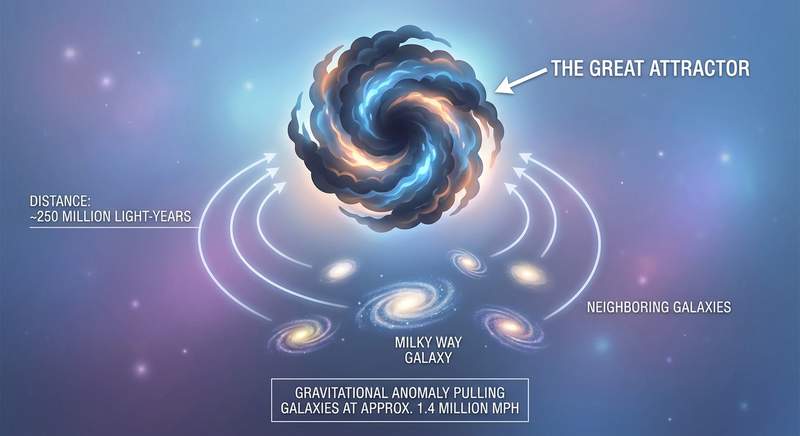
“The Great Attractor is a mysterious gravitational anomaly located about 250 million light-years away that is pulling our Milky Way and hundreds of thousands of neighboring galaxies toward it at 1.4 million miles per hour. This massive concentration of matter is hidden behind the 'Zone of Avoidance,' where the dust and gas of our own galaxy’s disk block our view of the distant universe. It serves as the gravitational center of the Laniakea Supercluster, a vast web of galaxies that defines the local architecture of our corner of the cosmos.”
The Great Attractor is real, but the name makes it sound more mysterious and singular than modern cosmology really requires. The classic version says there is a gravitational anomaly roughly 150 to 250 million light-years away that is pulling the Milky Way and many neighboring galaxies toward it. Sky at Night presents the idea in exactly that broad way, and NASA’s Hubble page says the enormous mass concentrated in the Norma Cluster region means that part of space is known to astronomers as the Great Attractor and “dominates our region of the Universe.”
That said, the useful correction is that the Great Attractor is not one neatly bounded super-object lurking behind a curtain. It is better understood as a region of overdensity and converging galaxy motions. NASA’s Hubble explanation ties the label specifically to the Norma Cluster, Abell 3627, about 220 million light-years away. But the Nature paper defining Laniakea shows why the story grew more nuanced: once astronomers map peculiar velocities rather than just positions on the sky, they can describe large-scale gravitational basins and flow boundaries rather than treating every tug as one isolated mystery lump.
The historical puzzle arose because galaxies near us are not simply receding with the cosmic expansion. They also have “peculiar velocities,” motions superimposed on the Hubble flow. The Laniakea paper explains that if you subtract the mean cosmic expansion from observed velocities, the leftover motions can be used to infer the surrounding mass distribution. That is where the Great Attractor idea comes from: our galaxy and many others are drifting in a preferred direction strongly enough to imply a substantial mass concentration.
The reason it seemed especially mysterious is that the relevant part of the sky is hard to observe. NASA’s page says the Great Attractor lies in a region where the plane of the Milky Way both outshines and obscures background galaxies with stars and dust. Astronomers call this the Zone of Avoidance. It is not a supernatural blind spot; it is simply an observational headache. Sky at Night emphasizes the same problem and notes that the region long resisted straightforward mapping.
That is why the Great Attractor was once described as an “anomaly.” The anomaly was not that gravity broke physics. The anomaly was that observed motions implied hidden mass in a place where the Milky Way makes optical observations difficult. NASA’s Hubble article points to the Norma Cluster as the nearest massive cluster in that direction, while Sky at Night notes that the Milky Way and thousands of other galaxies are being drawn toward that part of space.
Modern mapping complicates the older, simpler version in an interesting way. The Nature Laniakea paper does not talk about our home region as though everything terminates at one magic point called the Great Attractor. Instead, it defines a whole supercluster boundary by tracing peculiar-velocity flows, naming that larger basin Laniakea. Within that framework, what earlier generations called the Great Attractor becomes part of a broader dynamical landscape. That does not mean the Great Attractor was imaginary; it means the label belonged to an early, lower-resolution description of a more intricate mass-flow environment.
There is also debate about how “ultimate” the Great Attractor really is. Sky at Night hints that the story does not end there, because still larger structures such as the Shapley concentration help influence galaxy motions on bigger scales. That is another reason to avoid phrasing the Great Attractor as a final gravitational kingpin. Local flows can point toward one region while that region itself participates in wider cosmic structure.
This makes the fact more interesting, not less. The Great Attractor was never a literal vacuum-cleaner monster pulling galaxies through space by magic. It was evidence that matter is distributed unevenly on colossal scales and that galaxy motions can reveal hidden structure even when ordinary optical images are obstructed. NASA’s Hubble page captures the observational challenge beautifully, while the Nature paper shows how velocity mapping turned that old puzzle into a richer picture of cosmic geography.
So the corrected takeaway is this: yes, the Great Attractor is a real and important cosmological feature, and NASA identifies the Norma Cluster region as the mass concentration traditionally associated with it. But the Laniakea work in Nature shows that the more modern view is about large-scale flow basins rather than one isolated mystery object, and Sky at Night reflects that broader context. The name survived because it is dramatic; the science matured because the universe is messier than a single label.