The Cosmic Microwave Background (CMB) Cold Spot is a massive...
The CMB Cold Spot is a real, unusually large cool patch in the microwave sky, but whether it is mainly a rare statistical fluctuation, an imprint of an aligned supervoid, or evidence for stranger physics remains unsettled.
Published
Filed under
Byline
 Brainblast archive
The fact
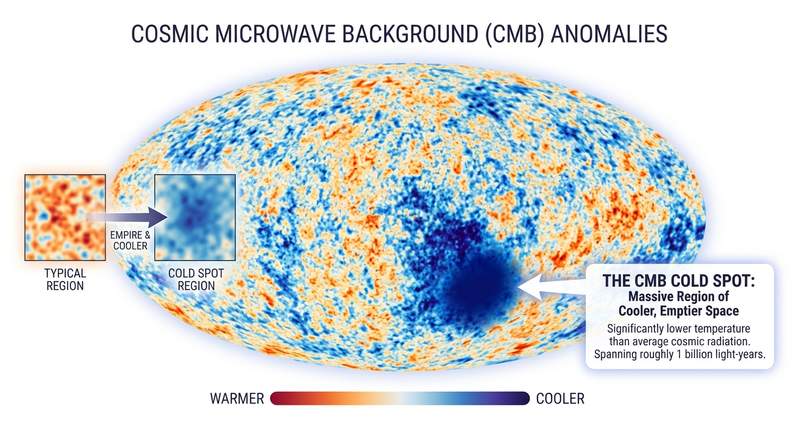
“The Cosmic Microwave Background (CMB) Cold Spot is a massive region of the universe that is significantly cooler and emptier than the rest of the cosmic microwave background radiation. Spanning roughly 1.8 billion light-years across, this "supervoid" contains thousands of fewer galaxies than expected by standard cosmological models. Scientists are baffled by its existence, as the Big Bang theory predicts that the temperature of the early universe should be almost perfectly uniform. Some controversial theories suggest the Cold Spot could be the result of a collision between our universe and another parallel universe, leaving a cosmic "bruise" on the fabric of space-time. Others believe it may be the largest structure ever discovered, challenging our fundamental understanding of how matter distributed itself after the birth of the cosmos. Whether it is a statistical fluke or evidence of a multiverse, the Cold Spot remains one of the greatest mysteries in modern astronomy.”
The Cosmic Microwave Background Cold Spot is one of the best-known large-angle anomalies in cosmology, and unlike some internet versions of the story, it is not just a made-up multiverse meme. ESA’s Planck mission confirmed that there is indeed a cold region on the microwave sky that is larger than expected under the simplest statistical picture of the standard cosmological model (https://sci.esa.int/web/planck/-/51559-hemispheric-asymmetry-and-cold-spot-in-the-cosmic-microwave-background). So the anomaly itself is real in the sense that it appears in high-quality sky maps. The hard part is explaining it.
The background to the problem is straightforward. The cosmic microwave background, or CMB, is relic radiation from the early universe. It is extremely uniform overall, but it contains tiny temperature fluctuations that trace primordial density differences. Cosmologists expect some hot spots and cold spots simply from random fluctuations. The Cold Spot stands out because it is both unusually large and unusually cold compared with what a simple Gaussian random field would most naturally produce.
That is why the feature generated two families of explanations. One possibility is that it is unusual but still ultimately a statistical fluke within standard cosmology. The other is that something along the line of sight, or something more exotic in the early universe, helped imprint an extra temperature decrement.
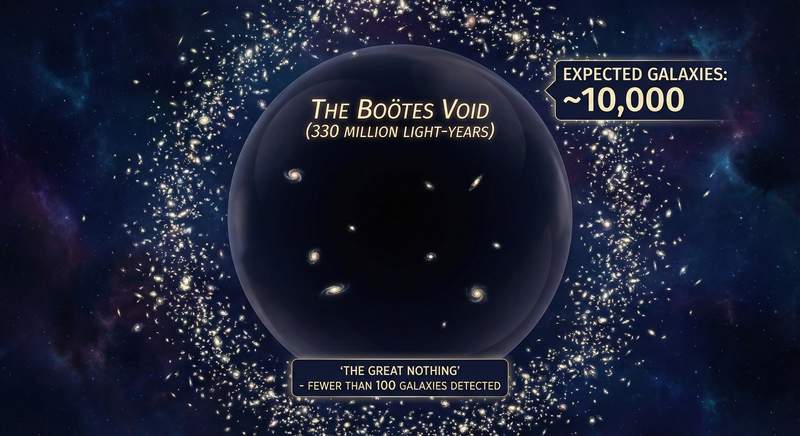
The most widely discussed conventional explanation involves a supervoid in the direction of the Cold Spot. In 2015, a University of Hawaiʻi-led team reported evidence for a vast underdense region aligned with the anomaly, describing it as roughly 1.8 billion light-years across and about 3 billion light-years away (https://www2.ifa.hawaii.edu/info/press-releases/ColdSpot/). The corresponding Monthly Notices of the Royal Astronomical Society paper is the study people are usually citing when they say the Cold Spot may line up with a giant cosmic void (https://academic.oup.com/mnras/article/450/1/288/994945).
The physical idea is that CMB photons passing through a huge underdense region can gain and lose energy asymmetrically as cosmic expansion changes the gravitational potential during their passage. That effect, related to the integrated Sachs–Wolfe or Rees–Sciama family of line-of-sight effects, could leave a colder patch in the observed microwave sky. In other words, the Cold Spot might not be entirely primordial; part of it could be a foreground imprint from large-scale structure.
Later work strengthened the case that an unusually large underdensity really is present in that direction. A 2022 MNRAS paper using Dark Energy Survey mass maps reported a robust detection of the Eridanus supervoid aligned with the Cold Spot (https://academic.oup.com/mnras/article/510/1/216/6468992). That is important because it means the supervoid idea is not just a one-off press-release flourish. There is continuing observational support for an aligned large-scale structure.
But this still does not mean the case is closed. One major caveat is that even proponents of the supervoid explanation have had to wrestle with whether the void’s expected imprint is strong enough, by itself, to account for the full amplitude and profile of the Cold Spot. The aligned structure appears real, yet many researchers have remained cautious about claiming it completely solves the anomaly. “Aligned with” is not the same thing as “fully explained by.”
That uncertainty is what leaves room for more speculative ideas, including the famous multiverse-collision suggestion. Those ideas are attention-grabbing, but they are far less established than the basic observational facts. Planck confirmed the existence of the anomaly in temperature maps, and large-scale-structure studies found evidence of an aligned supervoid. The leap from those observations to “bruise from another universe” is enormous, and mainstream cosmology does not treat it as the default explanation.
There is also a subtle issue of language. The Cold Spot is a cool patch in the CMB sky, not literally an empty hole in space itself. The suspected supervoid is a separate large-scale structure seen in galaxy distribution and mass maps along that direction. Popular summaries often blur the two together, as if the microwave anomaly and the underdensity were the same object. They are related hypotheses about line-of-sight cause and effect, not identical things.
The feature is scientifically valuable precisely because it sits near the edge of what the standard model comfortably expects. Most of modern cosmology works remarkably well, so anomalies like this attract outsized attention. They force researchers to test whether the model is missing something, whether the statistics of “rare but expected” events are being misread, or whether foreground structure is fooling us in a subtle way.
So the durable fact is this: the CMB Cold Spot is a genuine, unusually large cold region in the microwave background that survives high-quality observations, including Planck’s (https://sci.esa.int/web/planck/-/51559-hemispheric-asymmetry-and-cold-spot-in-the-cosmic-microwave-background). Evidence also supports a giant Eridanus supervoid lying in the same direction (https://www2.ifa.hawaii.edu/info/press-releases/ColdSpot/; https://academic.oup.com/mnras/article/510/1/216/6468992).
What remains unsettled is the punchline. The Cold Spot may be partly explained by that supervoid, may still be an unusually rare but standard fluctuation, or may yet require a subtler cosmological account. The one thing it probably is not is a finished mystery with a neat single-sentence answer.